
Pike County Court Records After an Arrest
Once a person is arrested and booked into the Pike County Jail, the prosecutor reviews the police reports and decides what to file. That filing opens a court case and becomes the court record for the matter. The Pike County State's Attorney, Walker R. Filbert, is the prosecutor who reviews law-enforcement reports and files the charges, assisted by Assistant State's Attorney Leecia Carnes on most criminal cases. The arrest is the trigger, but the court record is where the charges live.
It helps to keep the two records apart. The arrest and booking side shows up on the Pike County jail inmate records page, and any booking photo question belongs on the jail mugshots page. The court record itself is the charges the prosecutor filed, tracked through the case in the Circuit Clerk's index. After an arrest, those court records are what show the formal charges, the status, and the result.
How to Find Pike County Court Records After an Arrest
Court charges are searched through the Circuit Clerk's channels, not the jail page. The Pike County Circuit Clerk directs case inquiries to Judici, and Pike County Court runs a CaseLook record search behind a legal disclaimer. The Circuit Clerk page below is the verified starting point.
The Pike County Circuit Clerk page links the Judici case search and lists office hours and payment resources.
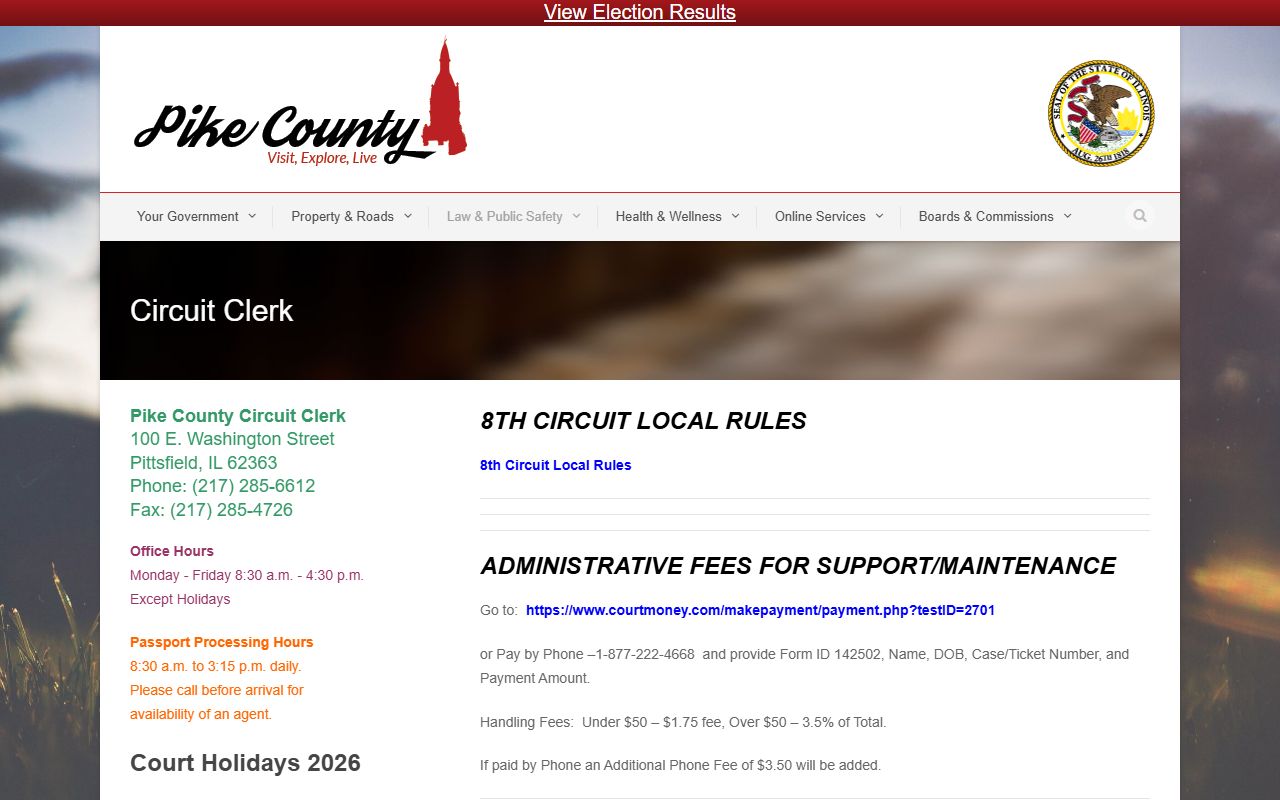
The clerk sits at 100 East Washington Street in Pittsfield, open Monday through Friday 8:30 a.m. to 4:30 p.m., and can produce verified copies the online tools cannot.
- Start with the sheriff's weekly arrest report for the arresting agency and initial charge.
- Open the Circuit Clerk's Judici link or the Pike County Court CaseLook search.
- Search by defendant name or case number after accepting the disclaimer.
- Open the case and read each charge's code, level, and current status.
For statewide criminal-history or conviction information, Illinois uses the State Police and Uniform Conviction Information Act channels, not the county jail page.
The Pike County Court Case Search
The online court search does not render a full field form to the public until the legal disclaimer is accepted. The CaseLook disclaimer page below is the gate, and the Judici link carries a court code that identifies Pike County. The field table shows what the public actually encounters.
The Pike County Court CaseLook page shows the disclaimer a user must accept first.
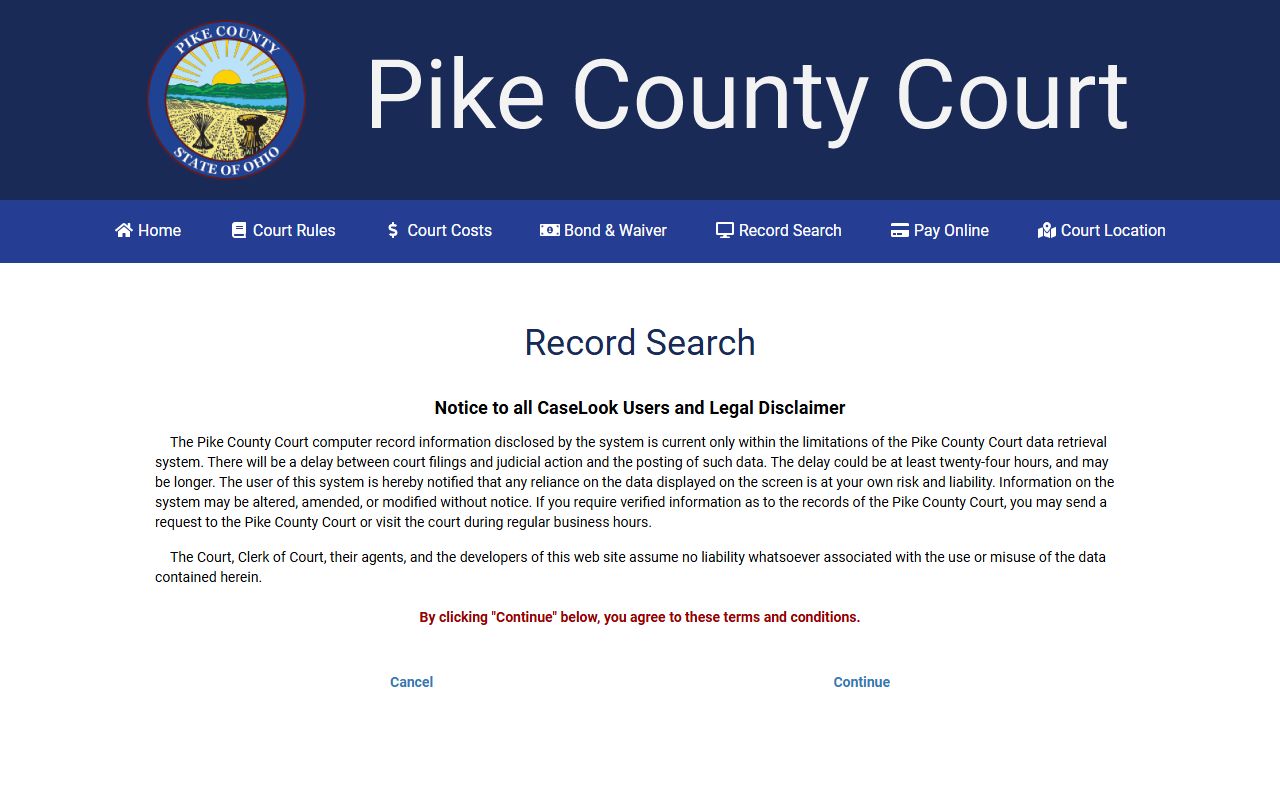
The disclaimer warns that posting can lag court filings by at least 24 hours and that verified records must be requested from or inspected at the court.
| Field | Type | Notes |
|---|---|---|
| Continue | Button | Must accept the legal disclaimer before any search. |
| Cancel | Button | Leaves the record-search process. |
| Case search fields | Form | Did not render in text-only inspection; use the court in person for verified records. |
| Judici court parameter | URL value | Code IL075015J identifies Pike County in the Judici link. |
| Judici captcha | Challenge | A humanity check can appear before results load. |
How Charges Get Filed After an Arrest: Complaint, Information, and Indictment
The court record starts with a charging document. After the arrest and booking, the prosecutor files one of three main types, and the type signals how serious the case is. A complaint is common for misdemeanors, an information is the prosecutor's formal felony charge in many cases, and an indictment comes from a grand jury for serious felonies.
| Complaint | Information | Indictment | |
|---|---|---|---|
| Filed By | Officer or prosecutor | Prosecutor | Grand jury |
| Common For | Misdemeanors | Many felonies | Serious felonies |
| Starts | The case | The case | The case |
A March 2026 sheriff release shows the path in action: an investigator submitted a report to the State's Attorney, who reviewed it formally before a warrant was issued. Not every incident becomes a filed charge, since some reports are still forwarded for review.
Charge Status in the Court Record
Charges change as a case moves, so the court record can look different from the booking charge. A prosecutor may amend, reduce, add, or drop counts, and a charge can be dismissed outright. The booking charge on the weekly arrest report is only the starting point, not the final word. The common status terms are defined below.
| Status | What It Means |
|---|---|
| Pending | The case is open and not yet resolved. |
| Amended / Reduced | The charge was changed or lowered from the original. |
| Dismissed | The charge was ended without a conviction. |
| Nolle Prosequi | The prosecutor chose not to pursue the charge. |
Release and Pretrial Decisions After an Arrest
Illinois has moved away from traditional cash bail under the Pretrial Fairness Act, so commercial bail bondsmen are not a routine Illinois option. Court and jail pages still use practical terms such as bond, body attachment, and payment review. The jail accepts cash, money order, or credit card, and credit or debit payments run through CourtMoney by phone with the Pike County code, the defendant name, date of birth, and amount. Holds and warrants can keep a person in custody even after money is paid.
| Channel | How It Works |
|---|---|
| Pretrial release | Decided by the court under Illinois pretrial law, not by posting a bondsman. |
| Cash or money order | Accepted at the jail to bond an inmate out. |
| CourtMoney credit / debit | By phone at 1-800-352-9870 with the Pike County code, name, date of birth, and amount. |
| Hold or warrant | A body attachment, parole warrant, or failure-to-appear hold can block release. |
Scam warning: The Pike County Sheriff has warned about fake calls demanding payment for GPS monitoring to release a loved one; Illinois Statewide Pretrial Services does not charge for GPS monitoring, so verify any payment request through official jail or court channels.
Warrants That Lead to a Jail Arrest
No standalone Pike County active-warrant search was located, so warrant information shows up indirectly. Weekly arrest entries list warrant pickups such as failure to appear, bench warrants, body attachments, and parole warrants, and the Circuit Clerk has a separate payment path for cases with active body attachments or warrants. Payments through that channel must be made five business days before the due date. To check on a warrant, contact the Circuit Clerk at 217-285-6612 or the sheriff at 217-285-5011, and consult an attorney before deciding whether the matter needs appearance, payment, or surrender.
Charges vs. Convictions in the Court Record
Being arrested and charged is not the same as being convicted. A charge is an accusation; a conviction is the result after a plea or verdict. Sheriff releases stress that arrested people are presumed innocent until proven guilty, which is why the court record, not the arrest, shows whether a case ended in a conviction.
| Charge | Conviction | |
|---|---|---|
| Stage | Accusation | Verdict or plea |
| Burden of Proof | Probable cause | Beyond a reasonable doubt |
| Public Record | Yes | Yes |
Sealed vs. Expunged Records After an Arrest
After a dismissal or an eligible outcome, an arrest or court record may be cleared. Illinois separates sealing from expungement, and the two have different effects. The State's Attorney page is the local office that reviews and prosecutes the cases that lead to these records, and the table sketches the difference.
The Pike County State's Attorney office reviews reports and files the charges that become court records.
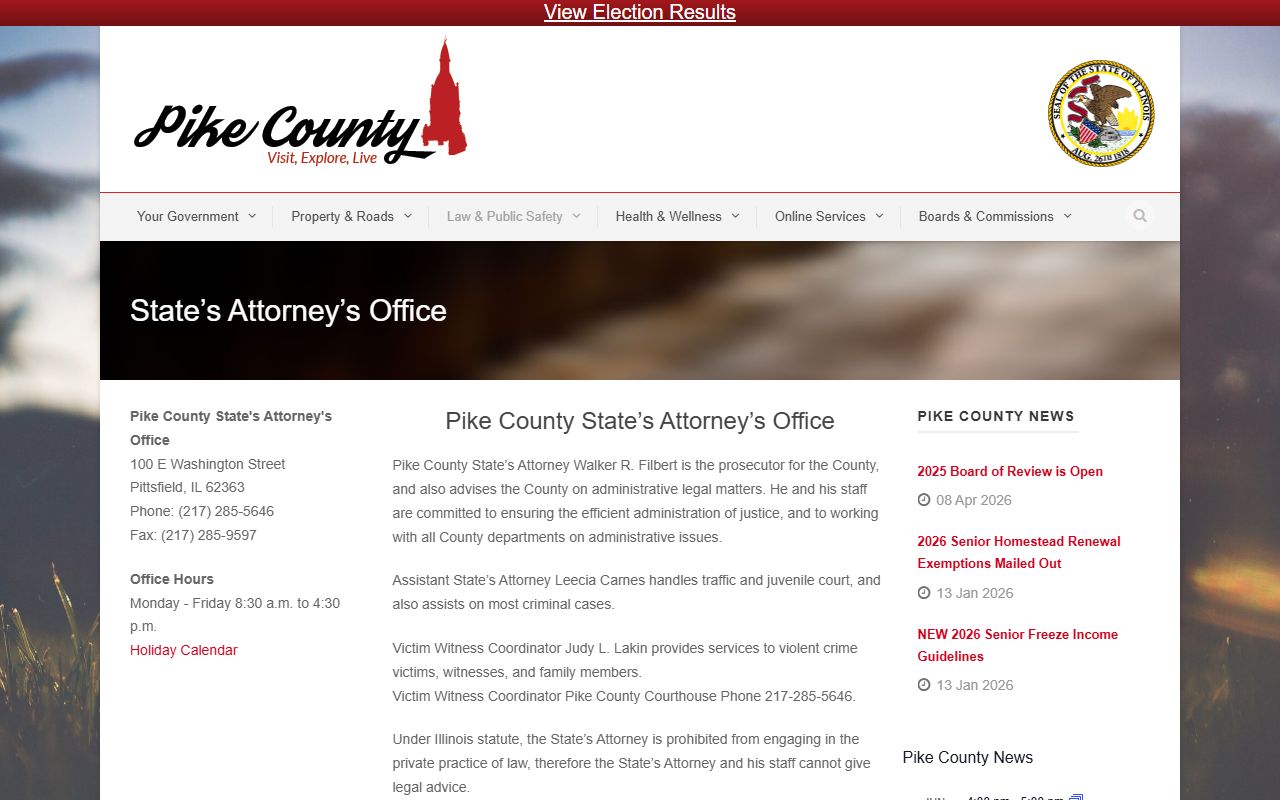
That office also houses the Victim Witness Coordinator, Judy L. Lakin, reached at 217-285-5646 for victims following a case after an arrest.
| Sealed | Expunged | |
|---|---|---|
| Visibility | Hidden from most public view | Destroyed or treated as if it never existed |
| Law Enforcement | Limited access remains | Very limited access |
| Eligibility | Set by Illinois law and the disposition | Set by Illinois law and the disposition |
Background Check Considerations
A casual name lookup is not the same as a regulated background check. Employers, landlords, and lenders that make covered decisions must use a process that follows the federal Fair Credit Reporting Act. Court records viewed for personal awareness do not carry those protections or duties.
Important: This site is not an FCRA-regulated consumer reporting agency, and its content may not be used for employment, housing, credit, or insurance screening.
Verified Copies and Older Court Files
Online court tools are convenient but limited. The Pike County Court CaseLook disclaimer warns that displayed data can be altered or delayed and that reliance is at the user's own risk. Judici, which the Circuit Clerk links, states plainly that it is operated by Judici.com and is not the court itself. For anything official, the verified record comes from the court.
To get a verified copy or to find an older case, contact or visit the Pike County Circuit Clerk at 100 East Washington Street in Pittsfield during office hours, Monday through Friday 8:30 a.m. to 4:30 p.m. The clerk can confirm a charge, a disposition, or a court date in a way an online snapshot cannot. Court payments for fines, fees, or cases with active body attachments run through CourtMoney or Judici, with handling fees of $1.75 under $50, 3.5 percent over $50, and an added phone fee, so confirm the right channel before paying.
Victim Notification and Case Follow-Up
People following a case after an arrest for personal safety reasons have two tools beyond the court index. The State's Attorney's Office houses a Victim Witness Coordinator, Judy L. Lakin, who supports violent-crime victims, witnesses, and family members and can be reached at 217-285-5646. For custody and release alerts, Illinois VINELink offers notifications. VINELink is a notification service, not the authoritative court record, so it works best alongside the Circuit Clerk's case information rather than in place of it.
Restricted Court Records After an Arrest in Pike County
Not every record after an arrest is open. Juvenile matters are restricted, sealed charges drop from public view, and some dismissed charges can be withheld. Records tied to an ongoing investigation may be exempt under the Illinois FOIA until the matter closes. When the online court tools or the sheriff page do not show a record, the verified path is a direct request to the Circuit Clerk for court files or a FOIA request to the sheriff for police records.